
All Things Visible and Invisible, by Phil Lawler

5 Powerful Quotes From St. Augustine’s Most Famous Work, the ‘Confessions’, by Kate Quiñones
August 28, 2025
The Truth About Abortion and Mental Health, by Samantha KochThe Truth About Abortion and Mental Health, by Samantha Koch
August 28, 2025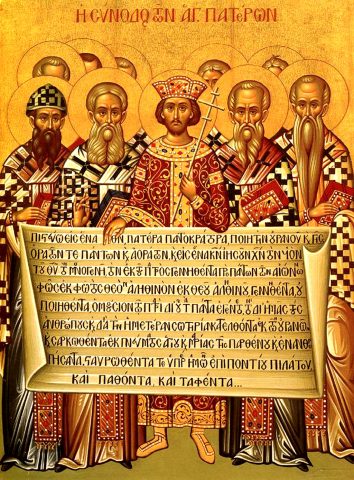
Nicene Creed. Icon depicting Constantine the Great, accompanied by the bishops of the First Council of Nicaea (325), holding the Niceno-Constantinopolitan Creed of 381. First line of main text in Greek: Πιστεύω εἰς ἕνα Θ[εό]ν, πατέρα παντοκράτορα, ποιητὴν οὐρανοῦ κ[αὶ] γῆς,. Translation: "I believe in one God, the Father the Almighty, Maker of heaven and earth."
By Phil Lawler, Catholic Culture, Aug 26, 2025
Phil Lawler has been a Catholic journalist for more than 30 years. He has edited several Catholic magazines and written eight books. Founder of Catholic World News, he is the news director and lead analyst at CatholicCulture.org. See full bio.
 These words should look familiar:
I believe in one God,
The Father almighty
Maker of heaven and earth,
Of all things visible and invisible
The emphasis is mine, but the placement of that profession at the very start of the Nicene Creed should be enough to drive home the message. The Christian faith rejects the post-Cartesian conceit that everything real can be seen and felt, counted and measured. What we know, what we believe, and what we profess are not confined to what we can quantify.
Love is a reality, for instance, as is pain. They are not visible. But we can see their effects, and so we know that in some cases, at least, what is invisible drives what is visible.
Earlier civilizations generally believed that our lives were governed by forces that could not be seen: by the movement of the planets or the whims of the gods or the blessings and curses of long-dead ancestors. Christians as well as pagans took it for granted that our lives could be influenced by spirits, good and evil, who could interact with us without being detected. Today that sort of belief is not quite respectable—although, significantly, it is enjoying a new popularity in New Age fads and a resurgence of outright paganism.
Related posts

December 29, 2025

December 29, 2025


December 29, 2025