
Fr. Jason Charron: Leo and Bartholomew in Nicaea

Beware the Trojan Horse in the Synodal Church, by John Horvat II
December 9, 2025
Saint of the Day for December 10: Blessed Adolph Kolping (Dec. 8, 1813 – Dec. 4, 1865)
December 10, 2025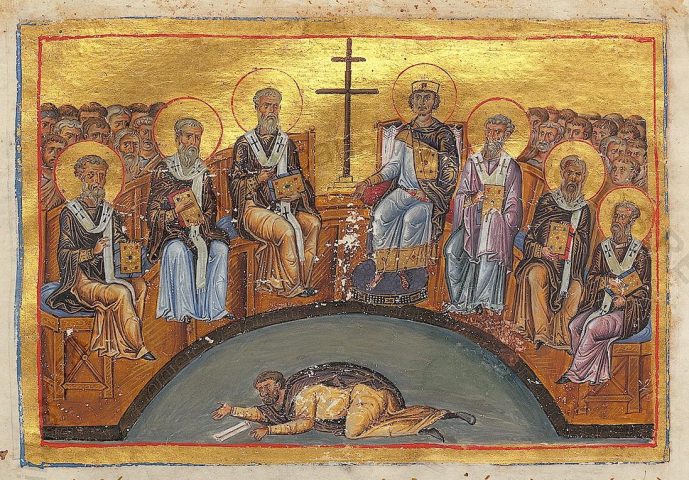
"Depiction of the Second Council of Nicaea from the Menologion of Basil II". 11th century. ... This work is in the public domain ....
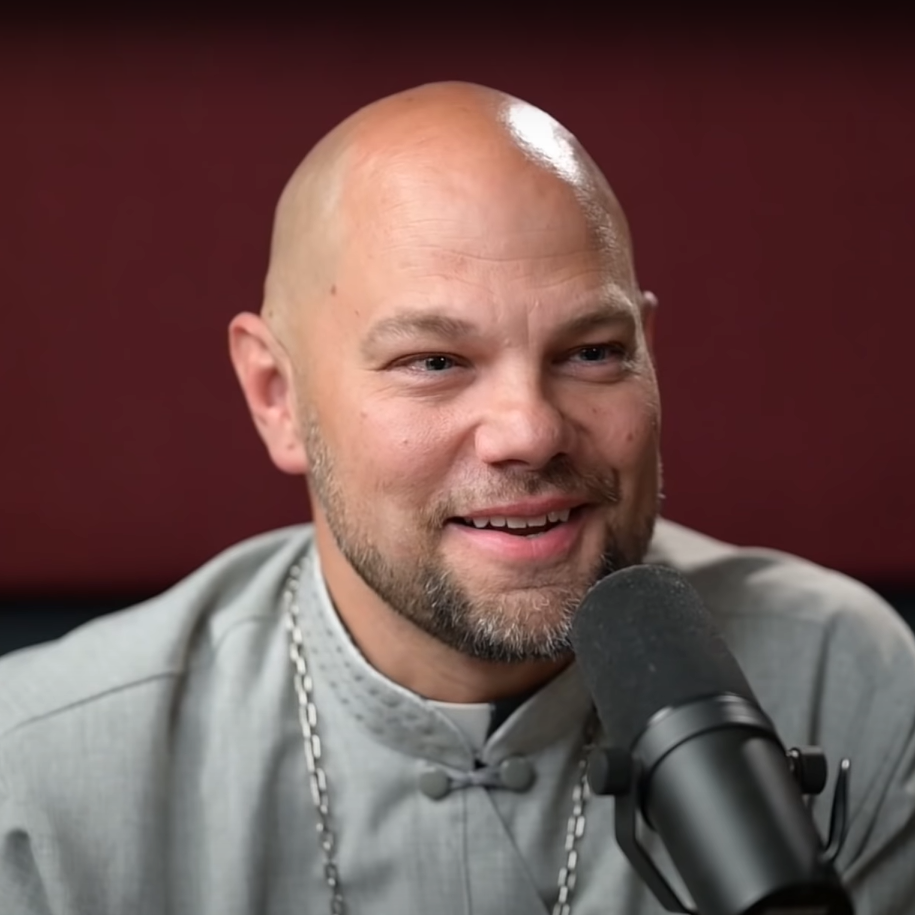
Fr. Jason Charron, Crisis Magazine, Dec. 10, 2025
Fr. Jason Charron was ordained to the priesthood in the Ukrainian Catholic Church for the Diocese of St. Josaphat in 2008. He has served in parishes in North Carolina, West Virginia and Pennsylvania, where he is currently pastor of Holy Trinity Ukrainian Catholic Church in Carnegie. Fr. Charron is a frequent guest on popular Catholic podcasts and is a retreat master. He and his wife, Halyna, are the parents of seven children, grandparents to one.
A reunification of Orthodoxy with Catholicism could remind each of what was lost in the schism.
 In the wake of the 1,700-year commemoration of the Council of Nicaea, where Pope Leo XIV and Ecumenical Patriarch Bartholomew I stood together on the soil of ancient İznik, the question of Church unity has taken on renewed urgency. Their meeting, at once liturgical and symbolic, recalled not only a shared origin but the enduring divergence of temperament that has shaped East and West. If unity is to be more than diplomatic choreography, it must engage the deeper currents of the distinct theological “styles” that define Catholicism and Orthodoxy.
Related posts

February 12, 2026
February 12, 2026


February 12, 2026