Notice: Function _load_textdomain_just_in_time was called incorrectly. Translation loading for the health-check domain was triggered too early. This is usually an indicator for some code in the plugin or theme running too early. Translations should be loaded at the init action or later. Please see Debugging in WordPress for more information. (This message was added in version 6.7.0.) in /nas/content/live/brownpelican/wp-includes/functions.php on line 6131

Notice: Function _load_textdomain_just_in_time was called incorrectly. Translation loading for the mfn-opts domain was triggered too early. This is usually an indicator for some code in the plugin or theme running too early. Translations should be loaded at the init action or later. Please see Debugging in WordPress for more information. (This message was added in version 6.7.0.) in /nas/content/live/brownpelican/wp-includes/functions.php on line 6131
Msgr. Charles Fink: What Does Love Look Like?  – Brown Pelican Society of Lousiana

Msgr. Charles Fink: What Does Love Look Like? 

Daily Scripture Readings and Meditations: You Will Know Them by Their Fruits
June 24, 2026
St. Augustine: The Church, Mother, and Virgin
June 24, 2026
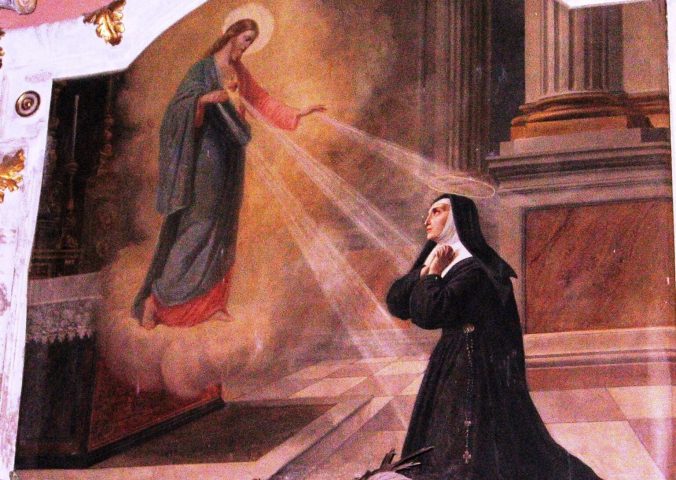
Jesus Christ appearing to St. Margaret Mary Alacoque, Church of San Michele, Cortemilia, Italy [Source: Wikimedia Commons].

By Msgr. Charles Fink, The Catholic Thing, June 24, 2026

Msgr. Charles Fink has been a priest for 50 years in the Diocese of Rockville Centre. He is a former pastor and seminary spiritual director, living in retirement from administrative duties at Notre Dame Parish in New Hyde Park, NY.


It’s a commonplace observation that most people think more readily in pictures than in abstract concepts, and that stories move and transform us in ways that logical arguments often don’t.  God, who of course knows this, therefore has revealed Himself to us, as C.S. Lewis put it, by writing Himself into a part in our story – at once author of the whole and character in the play, so to speak – and over the centuries, bequeathing to us a series of vivid images that, as the saying goes, are worth thousands of words.

Three of these images, or pictures, are closely related, even though great swaths of time separate the production of each by the Divine Artist.  The first and most ancient is the Crucifix, depicting the death of Christ on the Cross.  How odd that it adorns our churches, our homes, even our persons, symbol as it is of such tragic human inanity and brutality and a reminder of what we’re all capable of in our worst moments.  …

Continue reading >>>>>>>>>