
The Liturgy Wars You Will Always Have with You, by David G. Bonagura, Jr.

Saint of the Day for December 16: Blessed Honoratus Kozminski
December 16, 2025
Analysis: Inside the House GOP’s Battle Over Health Care, by George Caldwell
December 16, 2025
Latin mass. Cupich, Chinese celebration
By David G. Bonagura, Jr., Catholic Culture, Dec 15, 2025
David G. Bonagura, Jr. is an adjunct professor at St. Joseph’s Seminary and Catholic International University. He is the author of 100 Tough Questions for Catholics: Common Obstacles to Faith Today, and the translator of Jerome”s Tears: Letters to Friends in Mourning. He serves as the religion editor of The University Bookman, a review of books founded in 1960 by Russell Kirk. . See full bio.
 Advent afficionados likely have heard Creator of the Stars of Night on recording or at a concert, or perhaps read it in a prayer book. Translated into English by the Anglican clergyman J.M. Neale in 1852, the original hymn entitled Conditor Alme Siderum, composed in the seventh century, had dominated Advent hymnody for nearly a millennium—until a small committee in Rome consisting of four Jesuits and four other priests, at the behest of Pope Urban VIII, decided revision was needed.
Conditor’s shortcoming, in the mind of this committee still in the throes of the late Renaissance, was that its Latin lacked the purity of antiquity. For these cognoscenti, using vocabulary unknown to Virgil and Cicero was a venial sin; employing the most gauche of all poetic techniques—rhyming—was grave matter. No longer able to tolerate such infidelity, the committee, with the direct involvement of Pope Urban, took up its hammer. It destroyed all but the original hymn’s second line to express a similar Advent theme but with “authentic vocabulary” and a true classical meter. …
Related posts

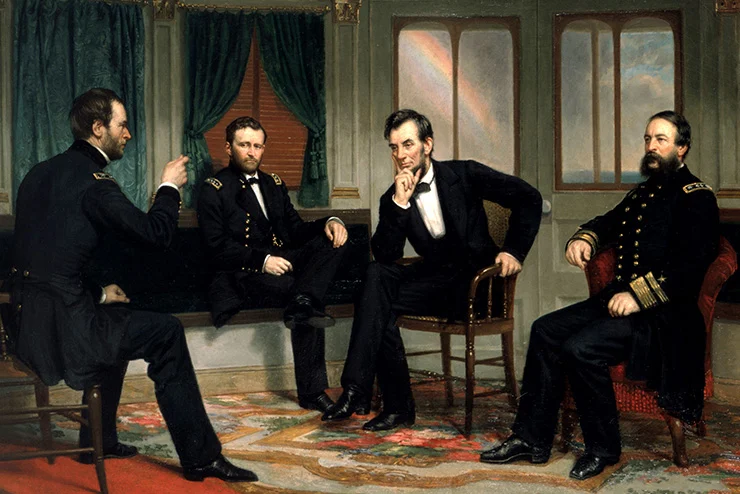

“The Peacemakers” (1868) by George Peter Alexander Healy, depicting a Union military strategy meeting in 1865. From left to right: Major General William Tecumseh Sherman; U.S. Army Commanding General Ulysses S. Grant; President Abraham Lincoln; and Rear Admiral David Dixon Porter (The White House Historical Association)